

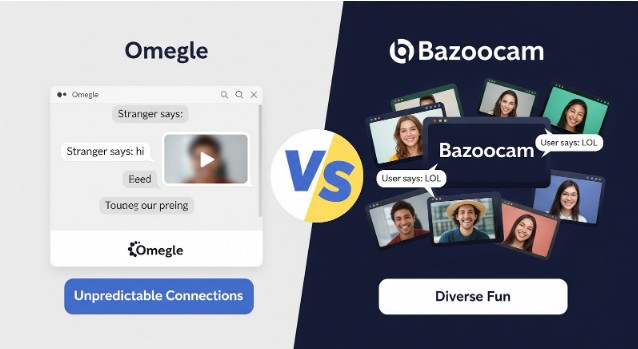
Let’s settle this the only reasonable way: like a chaotic little game show where two random video chat platforms walk onto the stage and we judge them on actual fun, not marketing fluff, not nostalgia, not “my friend said…”.
On the left: Omegla, modern, fast, built for that “click → match → vibe check” loop. It’s positioned as a no-signup, free random 1-on-1 video chat with “Next” skipping, interest filters, and even user photos.
On the right: Bazoocam , an older-school classic in the random chat world, known for a super simple experience plus quirky extras like mini-games and some region/language filtering.
Now the real question:
Which one is more fun in real life, tonight, when you actually want to talk to strangers?
Let’s run the rounds.
Round 1: Speed to the first laugh
If you’re using random video chat, you’re not here to “explore features.” You want the dopamine hit of a fast match.
Omegla: quick, direct, no ceremony
Omegla leans hard into one-click matching and the classic “Next” loop, no account required, jump in instantly.
Bazoocam: also fast, but more “old internet”
Bazoocam’s appeal has always been: show up and you’re chatting. It’s a straightforward entry, but the vibe can feel more “wild west,” depending on the time of day and who’s online.
Fun verdict (Speed):
- If you want modern fast, Omegla wins.
- If you like retro fast, Bazoocam is still solid.
Round 2: Icebreakers and “uncomfortable silence resistance”
Here’s the truth nobody likes admitting: half of random chats fail because both people open with the emotional energy of an unplugged toaster.
So… which platform helps you break the ice faster?
Bazoocam’s party trick: built-in mini games
Bazoocam is often cited for mini-games like Tetris / Tic-Tac-Toe-style icebreakers, little things that give you something to do besides staring into a webcam like a confused statue.
That’s genuinely fun when:
- you’re shy
- you don’t know what to say
- you want a low-pressure “shared activity”
- you’re tired of the same “where you from?” loop
Omegla’s approach: conversation-first + interest filters
Omegla focuses more on the chat loop itself, plus interest-based filtering to match you with people who share your vibe.
That usually leads to faster real conversation, because:
- you get fewer totally-random mismatches
- you can open with the interest itself (“Oh you’re into X too?”)
Fun verdict (Icebreakers):
- If you want “let’s play something and talk,” Bazoocam takes it.
- If you want “let’s talk with fewer dead ends,” Omegla takes it.
Round 3: The vibe , “chaos fun” vs “clean fun”
This is the big one.
Bazoocam’s vibe: classic chaos
Bazoocam has that older random-chat energy. Sometimes it’s hilarious. Sometimes it’s… a speedrun to the Next button. The randomness is the point, but it can be a little more unpredictable.
Omegla’s vibe: smoother, cleaner, more curated-feeling
Omegla positions itself as fast, anonymous, and “totally ads free,” with a more polished experience and extra tools (like interest filters and user photos) meant to reduce pure randomness into “random, but not pointless.”
If you’re measuring “fun” as:
- fewer interruptions
- fewer scammy feelings
- more actual conversations per minute
…then Omegla’s style usually wins.
Fun verdict (Vibe):
- Want chaotic roulette energy? Bazoocam.
- Want “I’m here for fun, not friction”? Omegla.
Round 4: Safety + community rules (the part that decides whether fun lasts)
Random video chat is only fun when you feel in control.
Bazoocam: reporting is part of the terms
Bazoocam’s terms mention a “Report a misuse” button and that the site can disable or sanction users for misuse.
Omegla: “safer space” positioning + parental controls language
Omegla explicitly talks about building a safer space, mentions parental control protections, and frames moderation as part of the experience (while also reminding users to protect their privacy).
Fun verdict (Safety & community):
Omegla feels more “designed for 2026 expectations,” where safety tools and norms aren’t optional extras, they’re what make you come back.
Round 5: Filters and finding “your people”
This is where modern random chat either becomes amazing or stays random noise.
Bazoocam: region/language direction
Bazoocam is commonly described as offering geography/language-style filters, enough to steer you away from totally aimless matches.
Omegla: interest-based matching + preview via user photos
Omegla highlights interest filters and even user photos so you can get a sense of who you might meet.
That combination tends to increase:
- match relevance
- conversation momentum
- “I want to stay in this chat” probability
Fun verdict (Filters):
Omegla wins for “finding your vibe faster,” especially if you’re not in the mood to brute-force 40 Next clicks.
The Fun Scorecard (quick and honest)
Here’s how it shakes out for most people in 2026:
- Fastest start: Omegla
- Best icebreaker gimmick: Bazoocam (mini-games)
- Cleanest experience: Omegla (ads-free positioning + modern flow)
- Most “classic chaos” energy: Bazoocam
- Best for finding your vibe: Omegla (interest filters + user photos)
- Best for “I’m shy, help”: Bazoocam (games)
So… which is more fun?
Pick Bazoocam if you want:
- old-school random chat chaos
- mini-games to break awkward moments
- that “anything can happen” vibe
Pick Omegla.chat if you want:
- a faster, smoother, more modern chat loop
- interest-based matching to cut down on pointless matches
- a cleaner experience (including its ads-free claim)
- safety and control cues that feel built for today
My real-world verdict:
If “fun” means more good conversations per hour, Omegla.chat is more fun for most users, because it trims the friction and gets you to the good part quicker. If “fun” means chaotic unpredictability + silly icebreakers, Bazoocam can still win on the right night.
Quick safety note (because fun should not turn into regret)
No matter which one you use:
- Don’t share personal info (full name, phone, address, socials).
- Keep your background neutral on camera.
- If someone crosses a line: Next + report/block.
That’s not paranoia. That’s how you keep random chat fun long-term.